RevSec AI: Bridging the Gap Between Strategy and Execution
This post covers how I led the product discovery, technical architecture, roadmapping, and execution of RevSec AI—a unified and agentic pricing intelligence, product strategy, and RevOps platform for product teams, founders, and GTM. Featuring a 21-day stakeholder discovery sprint, strategic pivots in AI infrastructure, and a ~70% reduction in system latency.
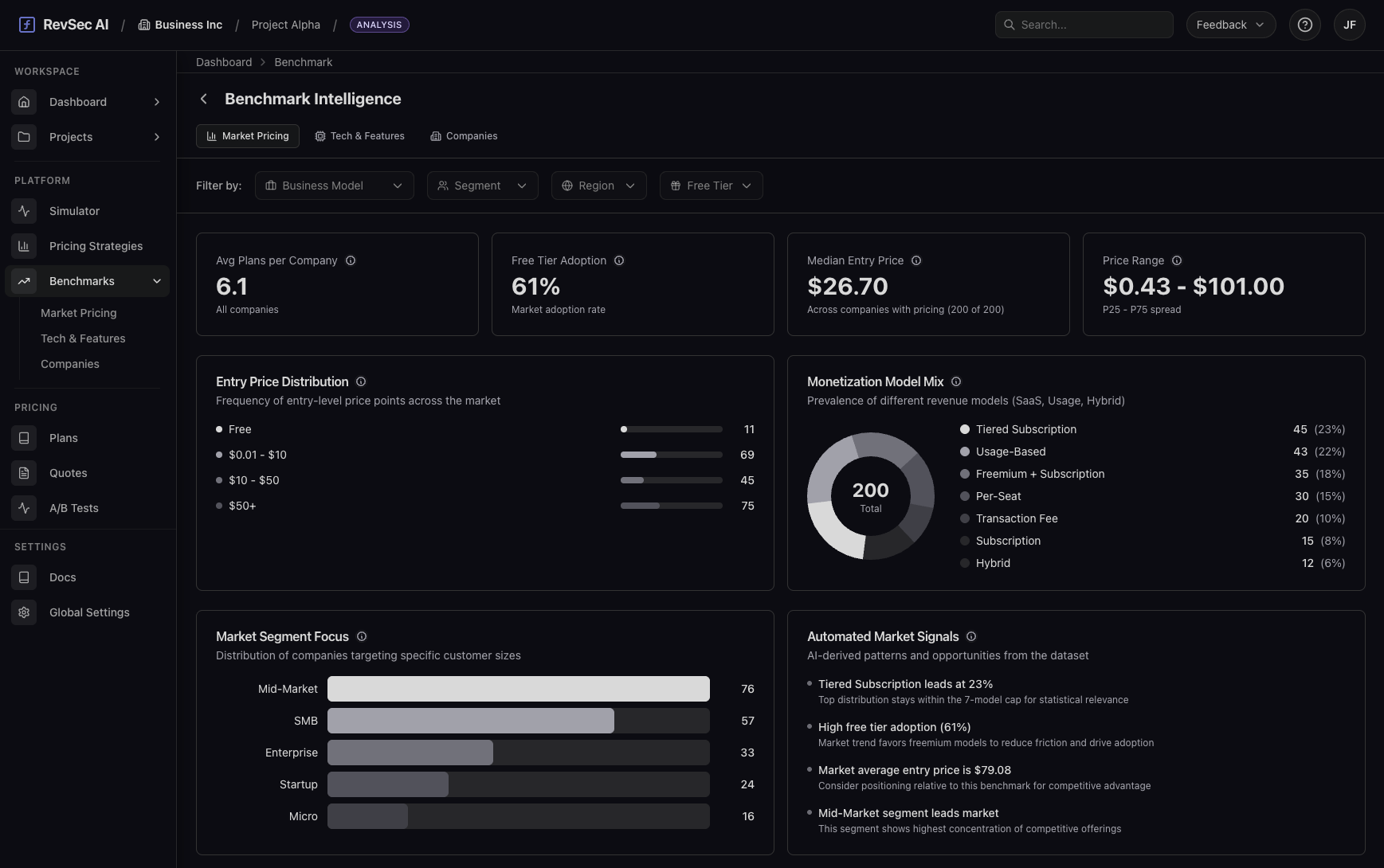
Table of Contents
- The Problem Space
- Discovery & Strategy Sprint
- The Solution: A Unified Operations & Strategy Workspace
- Technical Product Management & Pivots
- Systems Architecture
- Go-to-Market
- What This Demonstrates
Role: Technical Product Lead & Builder
Timeline: 6 Months (Zero to Production)
Stack: Nuxt 3, Rails 8 API, AWS Bedrock (Claude), Python, PostgreSQL, Pgvector, ActionCable, Stripe
Key Achievement: Reduced AI strategy generation latency by over 70% via architectural pivot — from ~60s to ~13-15s for full multi-module output.
Research Signal: 10+ Stakeholder Interviews (Founders/RevOps leaders).
The Problem Space
AI, API, and SaaS companies make pricing decisions using spreadsheets, gut instinct, and fragmented tools. Competitive intelligence lives in analyst decks nobody reads. Pricing experiments run without structured hypotheses — and most platforms don't support A/B testing for pricing strategy or product discovery.
Revenue operations teams juggle disconnected billing platforms, BI dashboards, and project management toolsets with no shared context. Pricing strategy becomes a bottleneck rather than a growth lever because research is never tied to execution.
Discovery & Strategy Sprint
To move beyond assumptions, I ran a 21-day intensive discovery sprint during a 4-week holiday in New York with my family. I conducted in-depth interviews with 10+ stakeholders — Founders and RevOps leads — to validate core hypotheses. This research transformed the product from a "tool for analysts" into a "unified workspace for operators."
Insight 1: The "Sterile Tool" Gap. Founders described their billing stacks as "obligations, not assets." This validated a UX-first differentiator — building a platform that prioritizes workflow design over basic utility.
Insight 2: Context Fragmentation. 80% of participants reported that strategic intent is lost when moving from research (spreadsheets) to execution (Jira/Stripe). This led to the decision to build Project Management as a core primitive, not a bolt-on.
Insight 3: The Need for Evidence. Competitive analysis showed a lack of structured A/B testing support across the pricing tool landscape. I prioritized an Experimentation Engine to allow teams to run hypothesis-driven pricing tests with full performance monitoring.
Insight 4: Usage Data Gaps. Ongoing market research revealed that usage-based pricing models are increasingly common but poorly supported by existing tools. This drove the decision to build usage-rate metering and analytics as a core intelligence surface — not billing, but data that informs strategy.
The Solution: A Unified Operations & Strategy Workspace
RevSec AI replaces the patchwork of tools with seven integrated "agentic" surfaces, connected through a unified data layer, and built to support both synchronous and asynchronous collaboration across each service:
Core Surfaces
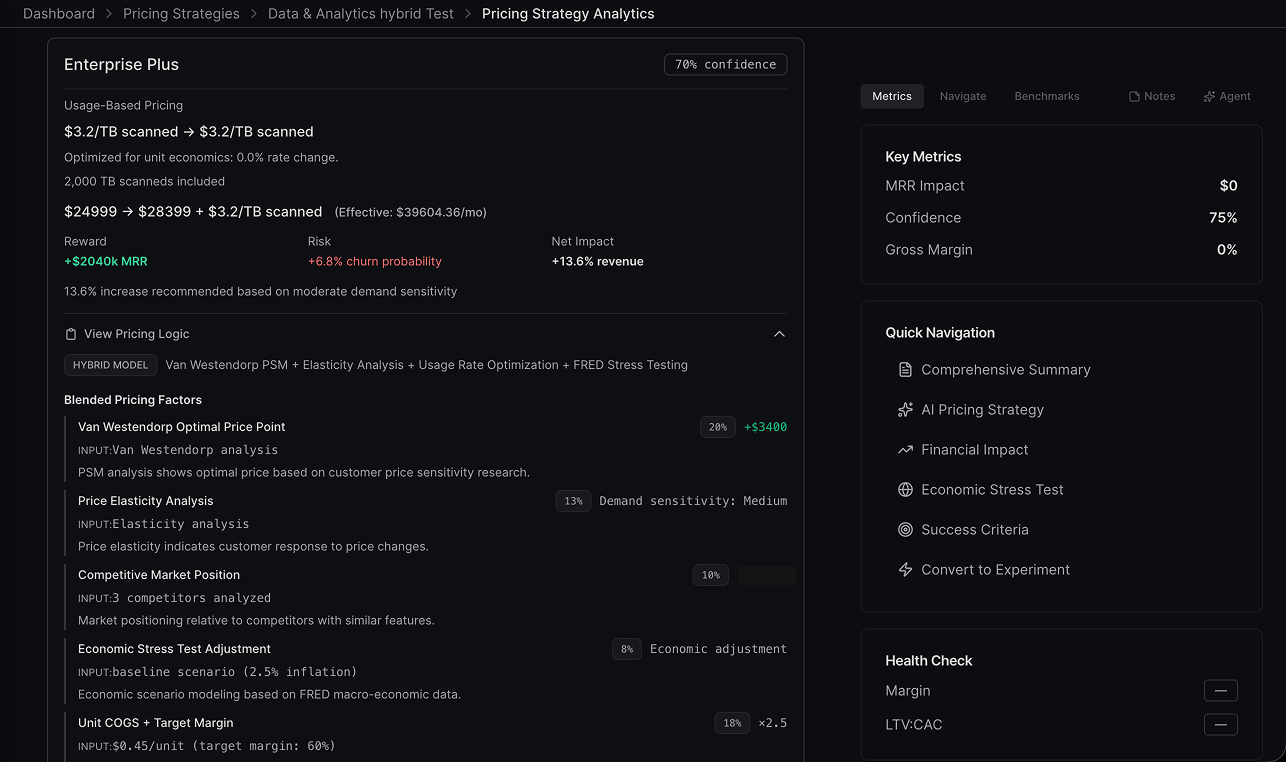
Interactive Pricing Strategy Engine — A 12-part statretgy synthesis/ discovery document, deterministic AI-powered pipeline producing pricing strategy tables, Monte Carlo simulation with probabilistic outcome modeling, financial modeling & health dashboards (unit economics, cash flow, sensitivity analysis), comparative analysis with AI synthesis, macroeconomic impact via FRED data integration (users can also model specific economic scenarios against a given strategy), recommended moves, and full logic trace transparency. No black boxes — every recommendation shows the complete reasoning chain.
A strategy instance can be converted to an experiment for analysis and synthesis with experiment-level access to plan library & CPQ, allowing users to move from strategy to implemented plan or quote - with full access to agentic chat features, benchmark dataset from the experiment analytics view, and supports notes as part of the end users' analysis workflow.
A/B Testing & Experimentation — Structured hypothesis-driven pricing experiments with variant configuration, real-time performance monitoring, statistical significance tracking, experiment notes, and direct connection to simulation snapshots. Experiments carry full context from the strategy that informed them.
Usage Events & Metering — Deep usage analytics with a text-to-SQL query engine, integrated SQL editor, metering configuration, and SDK-based event ingest. Usage data powers more accurate AI strategy generation and financial modeling. Built for intelligence, not billing.
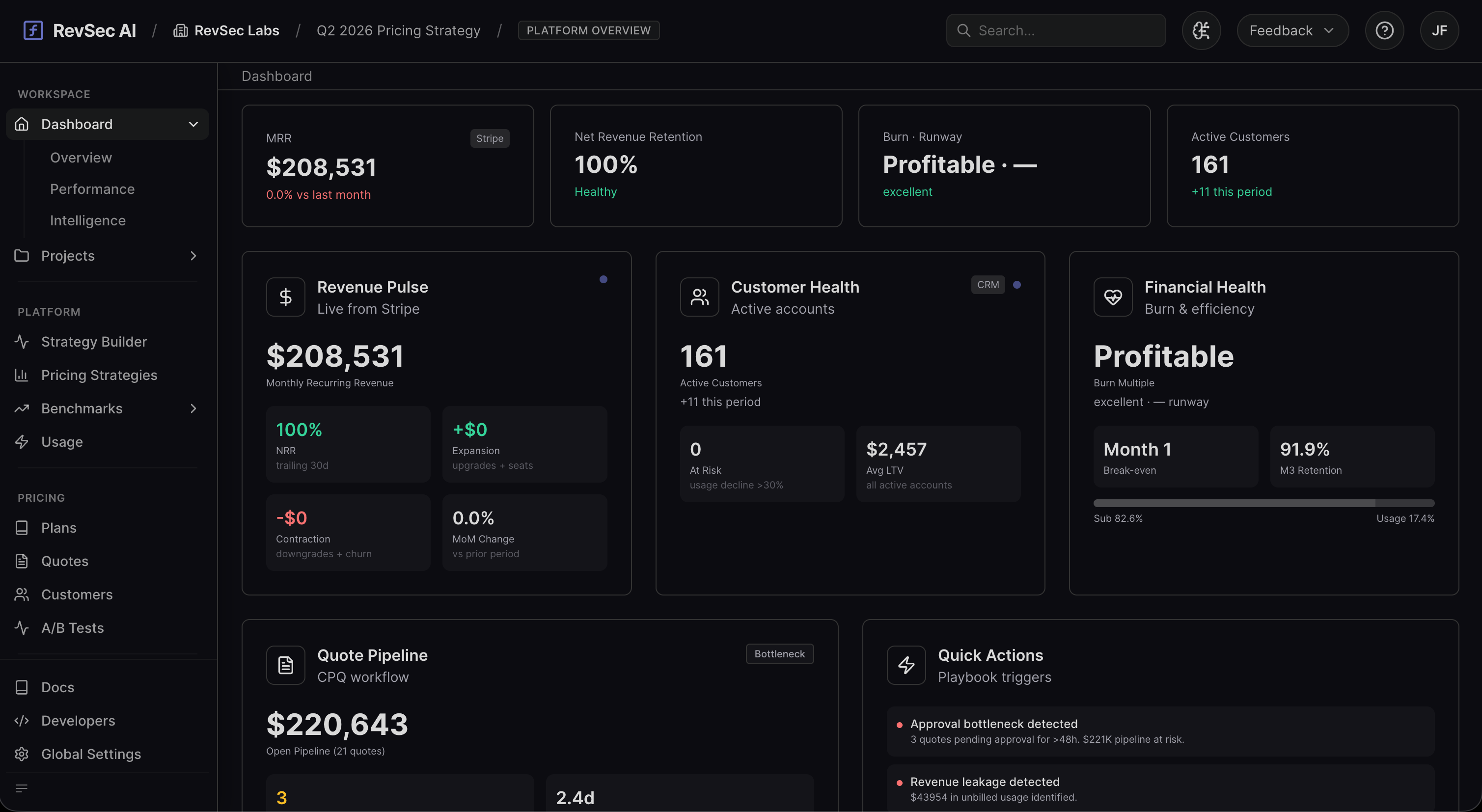
RevOps Analytics Dashboard — Strategic metrics, revenue trend modeling, financial health indicators, and experiment performance tracking with live and projected data modes. (Live ingested / platform data view and a strategy-based analytics experience).
Plan Management & CPQ — Full plan lifecycle from draft to published with entitlements, usage-based tiers, volume discounts, quote generation with approval workflows, and bidirectional Stripe sync. Designed to surface actionable intelligence inline rather than treating configuration as a sterile form.
Competitive Benchmarking — RAG-enhanced company-level pricing analysis with feature matrices, tech-stack comparisons, price percentile distributions, and market positioning charts. Powers intelligence across multiple platform surfaces.
Project Management — Kanban boards, Gantt timelines, calendar views, task hierarchies with milestones, resource pages for long-form documents and PRDs, discovery windows, and experiment windows, and more. The connective layer that ties every other surface together — so a pricing experiment created from a simulation snapshot carries its full context into the project timeline.
Platform-Wide Intelligence
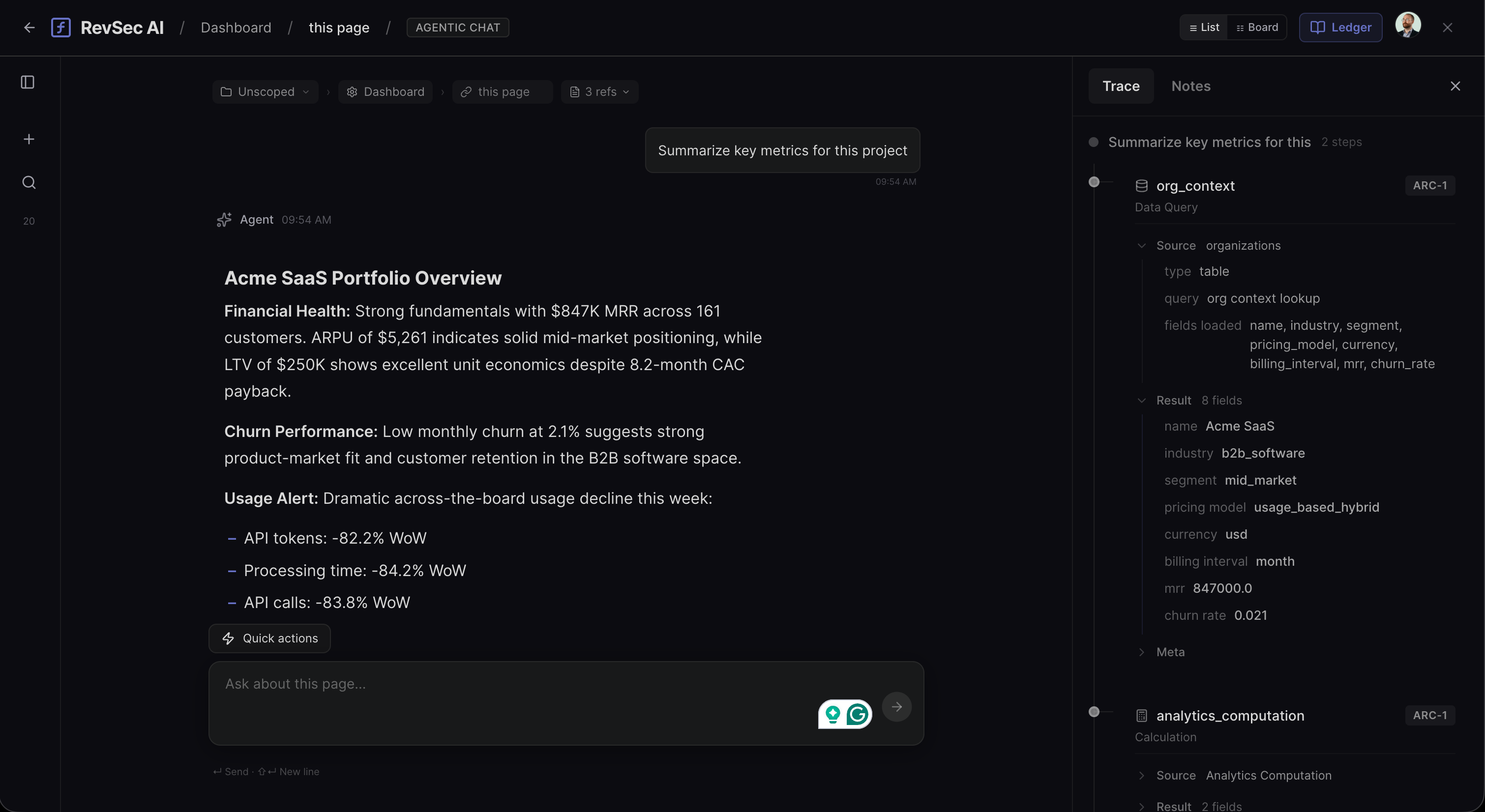
Agentic Chat — Natural language interface to all platform data and workflows. Ask questions about your business metrics, competitive landscape, or usage patterns and get answers grounded in your actual data.
Developer Portal — API key management, webhook configuration, SDK (
@revsec/sdk), sandbox environment, plan-as-code, AI usage monitoring, and audit logs. Built for teams that need programmatic access to pricing operations.Customer Management — Customer profiles with usage analytics, financial health metrics, activity timelines, and segment analysis. Architected to support customer-level pricing simulation (model pricing changes against a given user based on usage events and platform data) and deal modeling for GTM/sales ops.
Core Design Principle: The platform enforces a structured workflow from discovery → simulation → experiment → execution. Every pricing decision is traceable back to the research and modeling that informed it.
Technical Product Management & Pivots
As both the PM and lead developer, I managed several critical technical trade-offs to ensure the platform met professional-grade standards:
Performance Optimization
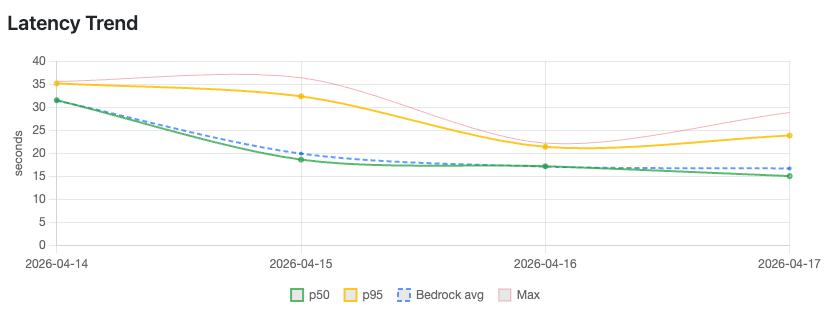
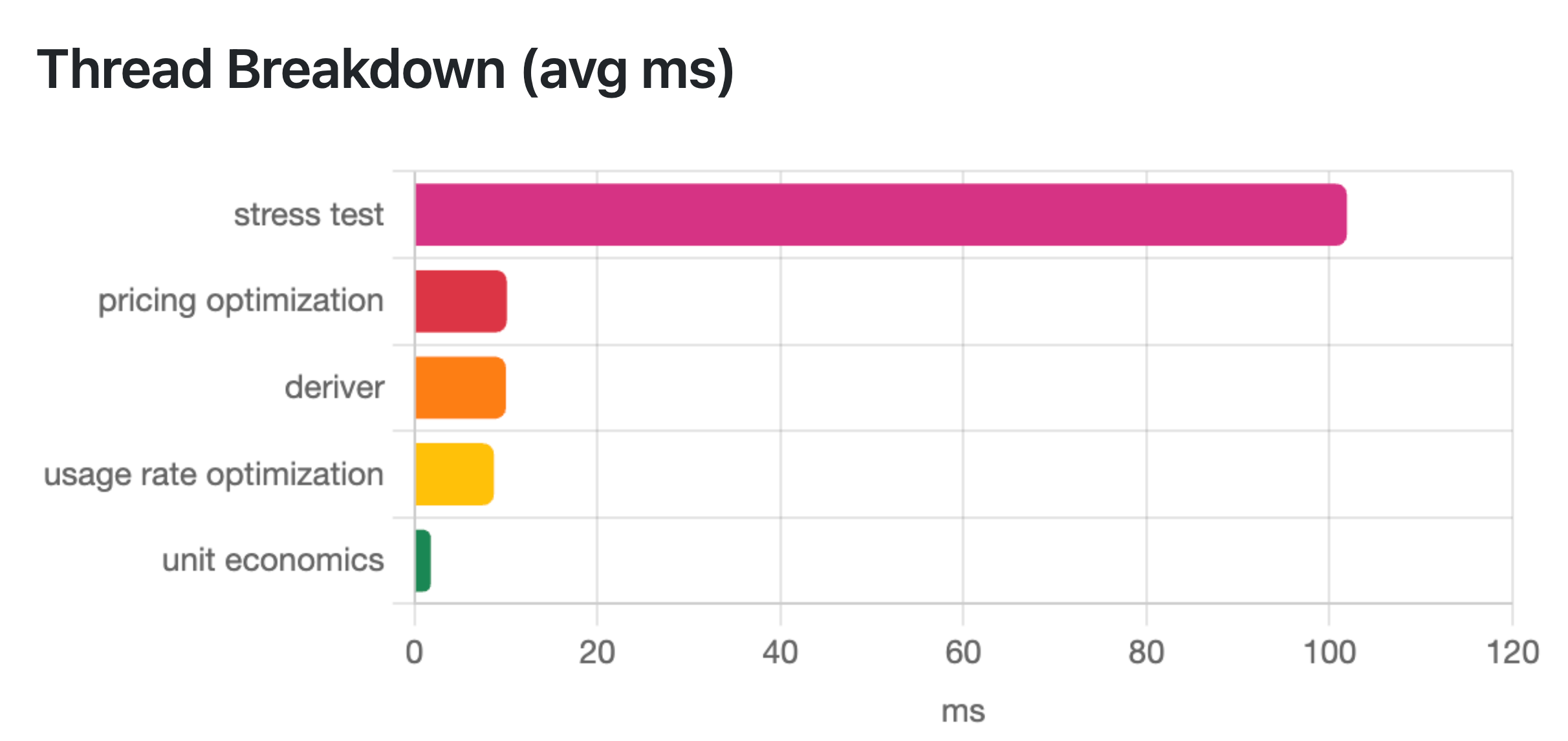
Initial testing of AWS Bedrock showed ~60-second latency for strategy generation (full 12-module output including pricing strategy table, financial modeling charts, success criteria, competitive analysis, and recommended moves). By migrating to a synchronous parallel pipeline and optimizing token consumption, I reduced latency by over 70% to ~13-15 seconds — ensuring a responsive UX for enterprise users.
Strategic Feature Pivots
Analytics to Execution: I initially envisioned a pure analytics engine. User testing proved insights were "unauditable" without an execution layer. I re-scoped to include a CPQ layer and Stripe integration, doubling the platform's utility and "stickiness."
Usage-Rate Metering: Market research identified that usage-based pricing is increasingly adopted but poorly instrumented for strategy. I built usage event tracking for intelligence — powering more accurate simulations and financial models — while deliberately deferring billing-as-a-service to avoid competing with Stripe/Orb on their core competency.
Monte Carlo & Financial Modeling: Strategy recommendations needed quantitative backing. I built probabilistic simulation (Monte Carlo runs), unit economics derivation, financial health scoring, and FRED macroeconomic data integration — so recommendations are grounded in deterministic math, not just LLM synthesis.
Math First, AI Second
To ensure data integrity, I architected the system so that LLMs perform synthesis and communication, while core financial calculations — unit economics, Monte Carlo distributions, sensitivity ranges, cash flow projections — are handled by deterministic Ruby service objects. AI presents findings; it never decides.
Systems Architecture
Frontend: Nuxt 3 (Vue 3 Composition API), Tailwind CSS, Pinia state management, ApexCharts and Chart.js for data visualization, Tiptap for rich-text editing. Business logic lives in decoupled Vue composables (useSimulator, useMonteCarloRuns, useFinancialHealth, useUnitEconomicsDerivation, useUsageEvents, useAgenticThread), enabling logic reuse across dashboards without duplication. 130+ composables spanning every platform surface.
Backend: Rails 8 API with service-layer architecture, PostgreSQL with Pgvector for RAG embeddings, session-based auth with RBAC (owner, admin, editor, commenter, viewer), and multi-tenant organization support. RESTful contract across 12+ interconnected resources. Real-time collaboration via ActionCable with autosave and concurrent edit prevention. Onboarding flow for new organizations.
AI Engine: AWS Bedrock (Claude) orchestrated via parallel prompt chains for RAG-enhanced market analysis. Key pipelines include:
- Strategy generation — multi-stage prompt chains synthesizing business inputs into risk-scored recommendations with full calculation transparency
- Competitive benchmarking — RAG-enhanced ingestion of unstructured market data into structured company profiles with pricing model classification and market positioning scores
- Monte Carlo simulation — probabilistic outcome modeling for pricing strategies (1000+ scenario runs in <1.2s)
- Macro economic pulse — daily FRED data integration producing actionable insights for pricing decisions
- Agentic chat — natural language queries against platform data with threaded conversations
Data Integrity: Ingests live cloud pricing data and FRED macroeconomic data to power deterministic financial impact dashboards. External data is structured and validated before reaching AI synthesis layers.
Developer Platform: Published SDK (@revsec/sdk) for event ingest, entitlement checks, and pricing lookups. Webhook system for real-time event distribution. Sandbox environment for testing integrations.
Infrastructure: Fully deployed on AWS — EC2 for the Rails API, S3 for assets, RDS PostgreSQL, and Bedrock for AI inference. Shipped from zero to production in six months.
Go-to-Market
The GTM strategy is designed for capital efficiency. An automated inbound pipeline handles customer support and sales qualification — incoming requests are triaged by an AI agent that validates prospects (org size, current pricing model, intent signals) and drafts responses for human-in-the-loop review before sending. This allows the sales process to scale without headcount while maintaining quality during the pre-PMF phase.
The platform is self-funded for the first two years, with institutional fundraising timed to post-PMF traction signals.
What This Demonstrates
Product Discovery: Validated a UX-first thesis through 10+ founder interviews, competitive analysis, and continuous market research — then let data drive architecture and feature decisions rather than building on assumptions.
Technical Execution: Shipped a complex, multi-service production platform in six months as the product lead and developer. 130+ Vue composables, 12+ interconnected API resources, multiple AI pipelines, real-time collaboration, and a published SDK.
Strategic Scoping: Made deliberate decisions to build (usage metering for intelligence, Monte Carlo simulation, A/B testing), pivot (pure analytics → execution layer), and defer (billing-as-a-service) based on market signals — with clear expansion paths tied to customer demand.
Systems Thinking: Designed a unified data architecture where projects, simulations, experiments, plans, quotes, usage events, and customer profiles share context through normalized relationships rather than siloed feature modules.
Financial Modeling Depth: Built deterministic financial computation (unit economics derivation, cash flow modeling, sensitivity analysis, Monte Carlo probabilistic simulation) alongside AI synthesis — ensuring recommendations are mathematically grounded.
For a more detailed breakdown of this project, covering system architecture, product strategy, execution breakdown, roadmap development, and more.
You can also review the business landing page to learn more about the platform and review each core service and feature. RevSec AI Business Landing Page